




Read time: 9 minutes
What’s been happening in the networking and comms sector over the last 3 months?
Our Buyer Intelligence platform has been continuously tracking first-party buyer signals across our database, bringing you timely insights in the form of our latest networking and comms intent report.
Our mission? To help tech vendors keep their demand generation strategies tightly aligned to real market demand.
Published quarterly as part of our category-specific intent reports, our latest blog takes a deeper dive into the shifts most likely to impact your networking and comms — and how you can action these insights to drive success.
Ready to level up your strategy? Let's go...

This quarter vs last quarter: what’s changed?
Heading into Q1 2026, buyer behaviour in the networking and communications category shows a clear shift away from tool-led evaluation and towards operational performance, cost accountability and execution readiness. While security remains critical, buyers are now weighing network decisions through the lens of reliability, scalability and real-world impact on users and operations.
Four key shifts shaping Q1 2026:
Performance over protection
Performance issues such as latency and downtime are overtaking security as the primary operational concern across buying groups.
Cost pressure spreads
Cost management pressure has spread beyond senior budget holders, influencing mid-level decision makers earlier in the journey.
Operational convergence
Network evaluation is becoming broader, with buyers assessing how connectivity, security and management work together operationally.
Execution readiness
Decision-stage behaviour has shifted towards partner selection, implementation planning and execution confidence.
Overall, Q1 2026 demand reflects a more pragmatic buyer mindset. Networking investments are being justified on measurable outcomes, operational resilience and readiness to scale rather than feature sets or standalone tools.
Market snapshot
Here's what our latest networking and comms intent report reveals about the current market:
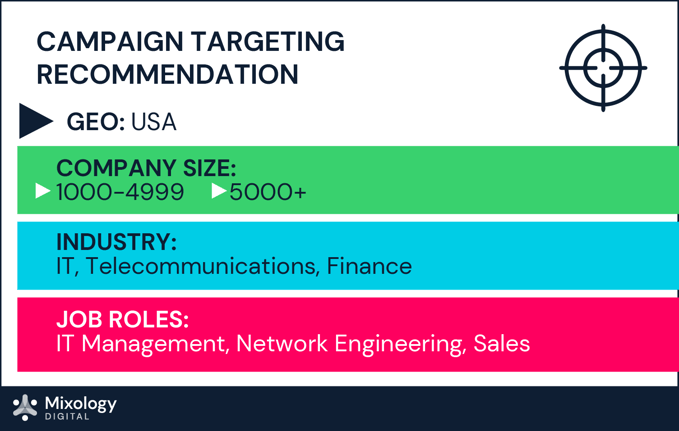
- Interest is strongest in the IT, telecommunications, and finance industries.
- Traction is highest among enterprises with 1,000–5,000+ employees.
- IT management, network engineering, and sales functions show the greatest engagement with networking and comms topics.
From insight to impact, here's how to apply our insight into your campaigns:
Targeting and segmentation action points:
1. Segment enterprise organisations in surging industries and geos into priority tiers.
2. Within these tiers, filter intent signals among trending job functions to inform topic clusters.
Why?
Segmenting your market into priority tiers helps to focus go-to-market teams on the accounts most likely to convert. Further segmentation techniques such as topic clusters opens up opportunities to tightly align content to specific audience segments. The result? Relevancy at scale.
Research patterns at account level
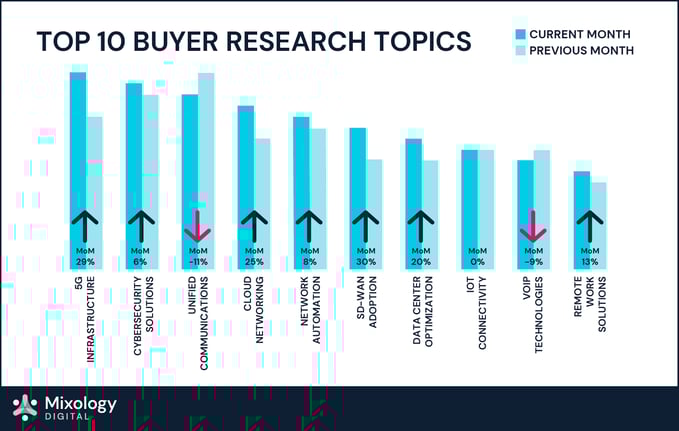
5 hot topics dominating research in the networking and comms space (over the last 3 months), are:-
5G infrastructure – Buyers are actively investigating causes of performance degradation as distributed workforces, cloud traffic and edge use cases put pressure on legacy architectures.
-
Cybersecurity solutions – Security concerns remain prominent, particularly where network exposure increases compliance and reputational risk.
-
Unified communications – Reliability continues to be a top operational risk, driving interest in resilience, redundancy and failover strategies across communication platforms.
-
Cloud networking – Buyers are grappling with fragmented stacks and the operational complexity of integrating SD-WAN, cloud, security and management tools.
-
Network automation – Research reflects the need to support growth, mobility and new workloads without increasing operational overhead through smarter, more automated network operations.
The topic showing the greatest decline in popularity is:
- Unified communications with an 11% MoM decrease
What do these insights mean for your content strategy?
To keep your strategy aligned to market demand, we recommend:
-
Lead with 5G infrastructure and cloud networking to frame performance, reliability and scalability challenges buyers are already researching. This is where awareness content should do the heavy lifting.
-
Follow with network automation and cybersecurity solutions in mid-funnel content, explicitly linking architectural choices to cost control, operational efficiency and risk reduction.
-
Position unified communications later in the journey, framed within the broader network and security ecosystem rather than as a standalone collaboration decision.
Pro tip: Use AI/NLP tools (topic modelling, entity extraction, semantic clustering) to audit your content library against competitor coverage. Flag underserved subtopics and build differentiated assets where demand is growing fastest.
Buyer group analysis
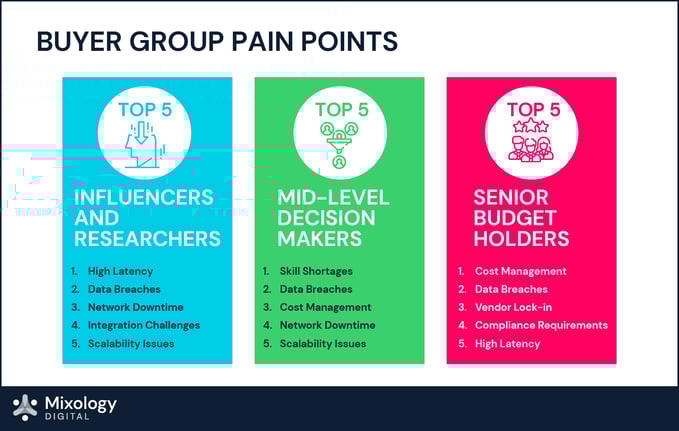
For networking and comms buyers, the pressure is no longer theoretical. As networks expand across cloud, edge, remote work and IoT environments, teams are being judged on how reliably connectivity performs, how securely data moves across the organisation, and how consistently the network supports real‑world operational scale, uptime and governance. Our report shows how the emphasis on these factors shifts by role and seniority.
What does this mean for your persona development?
Tailoring content to buyer role nuances is critical for engagement and conversion. Here's how you can translate these insights into accurate personas.
Persona A: Influencers and researchers (such as network engineers or solutions architects)
- Concerns: high latency, data breaches and network downtime are driving early-stage investigation as technical teams assess operational risk and performance bottlenecks.
- Content preferences: they want diagnostic content, architectural explainers and performance-led analysis that help them understand root causes and solution trade-offs.
Persona B: Mid‑level decision makers (such as network operations managers or IT ops managers)
- Concerns: skill shortages, cost management and downtime are shaping evaluation, as teams balance delivery responsibility with limited internal resources.
- Content preferences: they want comparative content, operational impact analysis and guidance on implementation complexity, tooling and ownership.
Persona C: Senior budget holders (such as CIOs or CTOs)
- Concerns: cost management, data breaches and vendor lock-in dominate, with a strong focus on long-term value, risk exposure and strategic alignment.
- Content preferences: they want business-led narratives that connect network investment to resilience, compliance, scalability and broader cloud or zero-trust initiatives.
Action point: Create a persona matrix aligned to job functions (e.g. network engineer vs. CTO). Map their pain points against the funnel stages they are most likely to participate in. For example, engineers may engage early (implementation and best‑practice content), while senior leaders will respond to BOFU tools like ROI models and rollout risk frameworks.
Recommended reading: How to map content to the new buyer journey
3 networking and comms demand gen plays:
Our AI Buyer Intelligence platform is able to interrogate research patterns by buyer stage. Here's how to action these insights into a full-funnel demand gen strategy aligned to real buyer behaviour:
Tip: Keep the exact keyword phrases in page titles, H2s, alt text, and internal links so performance teams can tie content to intent spikes and prioritise syndication/remarketing accordingly.
Ready to activate these insights?
Why not try our demand gen planning framework? It’s a collection of templates and planning aids, including:
- Buyer group intent mapping
- Multichannel campaign blueprint
- Funnel‑aligned strategy shortcuts
Everything you need to turn category intent insights into campaigns that convert.