



Read time: 9 minutes
What’s been happening in the enterprise software and ERP sector over the last 3 months?
Our Buyer Intelligence platform has been continuously tracking first-party buyer signals across our database, bringing you timely insights in the form of our latest enterprise software and ERP intent report.
Our mission? To help tech vendors keep their demand generation strategies tightly aligned to real market demand.
Published quarterly as part of our category-specific intent reports, our latest blog takes a deeper dive into the shifts most likely to impact your enterprise software and ERP campaigns — and how you can action these insights to drive success.
Ready to level up your strategy? Let's go...

This quarter vs last quarter: what’s changed?
Enterprise software and ERP buying behaviour continued to mature through Q4 2025, with buyers moving beyond adoption questions and into deeper evaluation, comparison and value realisation modes.
Compared to last quarter, cost scrutiny has intensified, research has shifted from rollout to ROI, and different buying roles are now optimising for very different success criteria.
Four key shifts shaping Q1 2026:
Cost and lock-in concerns have escalated
Implementation cost and vendor lock-in appear more frequently across buyer groups, particularly among senior budget holders, signalling tighter financial governance and longer approval cycles.
Evaluation has become more comparative
Buyers are spending less time questioning whether ERP is right for them, and more time comparing vendors, pricing models and long-term trade-offs.
Post-go-live readiness is now a decision driver
Change management, adoption and sustainment planning are entering the decision stage earlier in the journey.
Value extraction is overtaking adoption
Financial management is now the most researched topic, with business intelligence rising fast as buyers look to prove ongoing performance impact.
For Q1 2026, successful content strategies will reflect this shift by helping buyers justify decisions internally, manage risk and demonstrate long-term value rather than simply explaining ERP capabilities.
Market snapshot
Here's what our latest enterprise software and ERP intent report reveals about the current market:
- Interest is strongest in the manufacturing, retail, and healthcare industries.
- Traction is highest among enterprises with 1,000–5,000+ employees.
-
- IT management, finance, and operations functions show the greatest engagement with enterprise software and ERP topics.
-
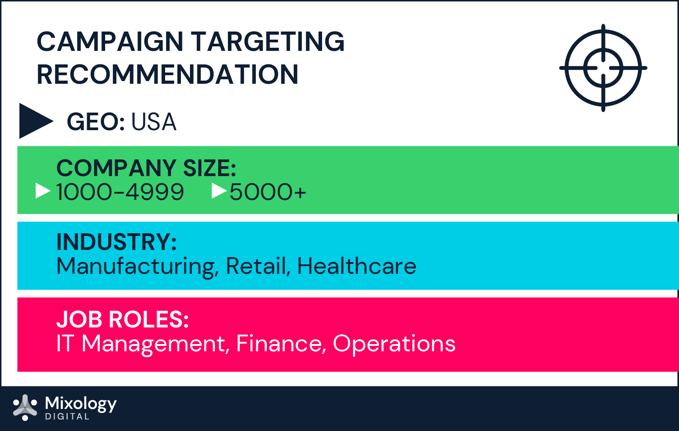
From insight to impact, here's how to apply our insight into your campaigns:
Targeting and segmentation action points:
1. Segment enterprise organisations in surging industries and geos into priority tiers.
2. Within these tiers, filter intent signals among trending job functions to inform topic clusters.
Why?
Segmenting your market into priority tiers helps to focus go-to-market teams on the accounts most likely to convert. Further segmentation techniques such as topic clusters opens up opportunities to tightly align content to specific audience segments. The result? Relevancy at scale.
Research patterns at account level
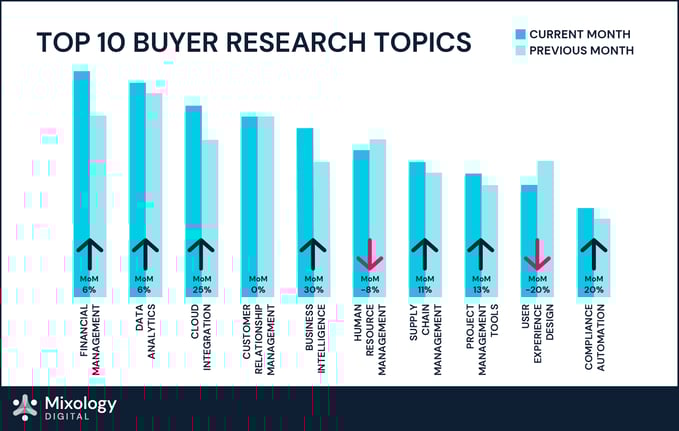
5 hot topics dominating research in the enterprise software and ERP space (over the last 3 months), are:-
Financial management – As the most researched topic this quarter, financial management signals a shift toward measuring ERP success through cash flow visibility, margin control and reporting accuracy.
-
Data analytics – Buyers are prioritising analytics capabilities that turn ERP data into usable insight, with emphasis on reporting accuracy, real-time visibility and decision support across finance and operations.
-
Cloud integration – This reflects growing scrutiny of how ERP platforms integrate across cloud environments and with existing systems, as buyers aim to reduce complexity, cost and dependency on bespoke integrations.
-
Customer relationship management – Buyers are increasingly focused on how ERP supports or connects with CRM platforms to improve customer visibility, revenue forecasting and cross-functional alignment.
-
Business intelligence – Interest in embedded and connected BI continues to rise as buyers look to extract measurable value post-implementation and justify long-term ERP investment.
The topic showing the greatest decline in popularity is:
- User experience design with a 20% MoM decrease
What do these insights mean for your content strategy?
To keep your strategy aligned to market demand, we recommend:
-
Shift from feature-led messaging to how ERP enables data analytics, business intelligence and CRM visibility, with clear links to financial control and decision-making impact.
-
Address cloud integration and adoption risk upfront, showing buyers how data flows across systems, teams and environments before contracts are signed.
-
Provide practical decision frameworks that help IT, finance and operations align on analytics requirements, integration trade-offs and long-term value measurement.
Pro tip: Use AI/NLP tools (topic modelling, entity extraction, semantic clustering) to audit your content library against competitor coverage. Flag underserved subtopics and build differentiated assets where demand is growing fastest.
Buyer group analysis
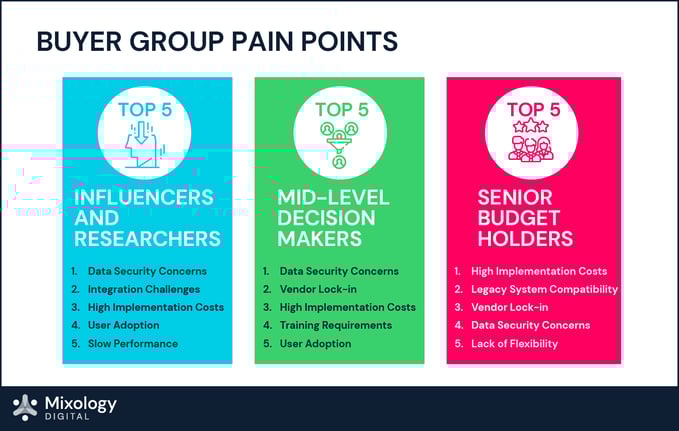
For enterprise software and ERP buyers, the pressure is no longer theoretical. As ERP environments expand across finance, operations and customer systems, teams are being judged on how well platforms integrate, how reliably data flows across the business, and how consistently ERP supports real-world operational scale and governance. Our report shows how the emphasis on these factors shifts by role and seniority.
What does this mean for your persona development?
Tailoring content to buyer role nuances is critical for engagement and conversion. Here's how you can translate these insights into accurate personas.
Persona A: Influencers and researchers (such as solutions architects or IT systems managers)
- Concerns: data security, integration complexity and rising implementation costs dominate early-stage research as these buyers assess feasibility and risk.
- Content preferences: they want technical clarity, architecture-level explanations, integration examples and evidence that ERP platforms can coexist with existing system.
Persona B: Mid‑level decision makers (such as operations directors or heads of IT)
- Concerns: vendor lock-in, implementation cost and training requirements become more prominent as accountability for delivery and adoption increases.
- Content preferences: they want comparison tools, implementation best practices, rollout timelines and clear explanations of standardisation versus customisation trade-offs.
Persona C: Senior budget holders (such as CIOs, CFOs or CTOs)
- Concerns: high implementation costs, legacy system compatibility and long-term financial exposure shape final decisions.
- Content preferences: they want ROI models, cost–benefit analysis, risk mitigation narratives and proof of sustained value post-implementation.
Action point: Create a persona matrix aligned to job functions (e.g. platform engineer vs. VP of Engineering). Map their pain points against the funnel stages they are most likely to participate in. For example, IT and systems leaders may engage early (implementation and best‑practice content), while senior leaders will respond to BOFU tools like ROI models and rollout risk frameworks.
Recommended reading: How to map content to the new buyer journey
3 enterprise software and ERP demand gen plays:
Our AI Buyer Intelligence platform is able to interrogate research patterns by buyer stage. Here's how to action these insights into a full-funnel demand gen strategy aligned to real buyer behaviour:
Tip: Keep the exact keyword phrases in page titles, H2s, alt text, and internal links so performance teams can tie content to intent spikes and prioritise syndication/remarketing accordingly.
Ready to activate these insights?
Why not try our demand gen planning framework? It’s a collection of templates and planning aids, including:
- Buyer group intent mapping
- Multichannel campaign blueprint
- Funnel‑aligned strategy shortcuts
Everything you need to turn category intent insights into campaigns that convert.