




Read time: 9 minutes
What’s been happening in the HR technology sector over the last 3 months?
Our Buyer Intelligence platform has been continuously tracking first-party buyer signals across our database, bringing you timely insights in the form of our latest HR technology intent report.
Our mission? To help tech vendors keep their demand generation strategies tightly aligned to real market demand.
Published quarterly as part of our category-specific intent reports, our latest blog takes a deeper dive into the shifts most likely to impact your HR technology — and how you can action these insights to drive success.
Ready to level up your strategy? Let's go...

This quarter vs last quarter: what’s changed?
HR technology demand continues to be shaped by persistent people risk, but buyer behaviour has become more pragmatic and delivery-focused as we head into Q1 2026. Compared to last quarter, buyers are moving faster from problem recognition into evaluation, with greater scrutiny on integration, compliance and post-implementation outcomes.
Four key shifts shaping Q1 2026:
People risk remains structural, not cyclical
High turnover, burnout and skills gaps continue to dominate across all buyer groups.
Compliance has moved beyond senior leadership
Regulatory and governance concerns are now visible across mid-level decision makers as well as budget holders.
Evaluation behaviour has intensified
Buyers are progressing from integration questions to side-by-side vendor comparison and ecosystem fit.
Delivery credibility matters more than ever
Decision-stage research is increasingly focused on implementation timelines, support models and adoption outcomes.
Overall, this signals a market that is no longer persuaded by feature-led messaging. Instead, HR tech buyers want confidence that solutions will stabilise their workforce and deliver measurable impact once deployed.
Market snapshot
Here's what our latest networking and comms intent report reveals about the current market:
- Interest is strongest in the IT, healthcare, and finance industries.
- Traction is highest among enterprises with 1,000–5,000+ employees.
- HR, IT and finance functions show the greatest engagement with HR technology topics.
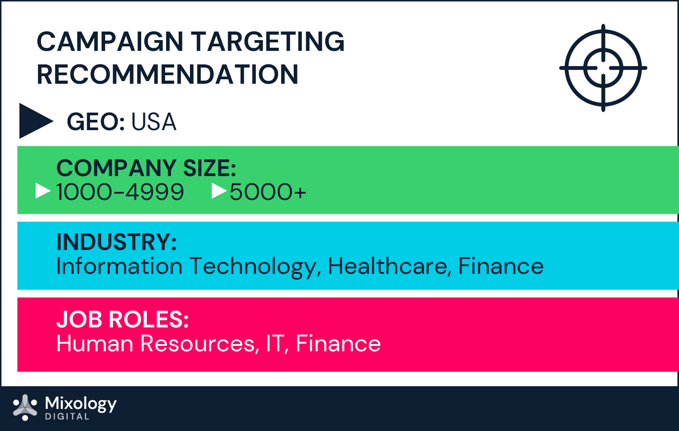
From insight to impact, here's how to apply our insight into your campaigns:
Targeting and segmentation action points:
1. Segment enterprise organisations in surging industries and geos into priority tiers.
2. Within these tiers, filter intent signals among trending job functions to inform topic clusters.
Why?
Segmenting your market into priority tiers helps to focus go-to-market teams on the accounts most likely to convert. Further segmentation techniques such as topic clusters opens up opportunities to tightly align content to specific audience segments. The result? Relevancy at scale.
Research patterns at account level
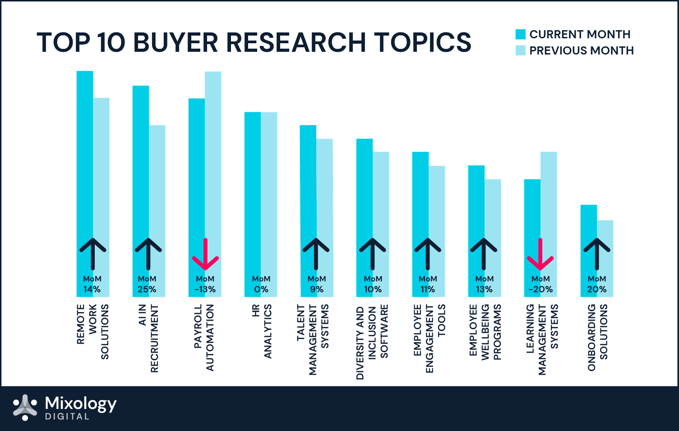
5 hot topics dominating research in the HR technology space (over the last 3 months), are:-
Machine learning models – Interest continues to accelerate as buyers explore predictive and automated decisioning beyond descriptive analytics.
-
Predictive analytics – Teams are increasingly focused on forward-looking insights that support planning, forecasting, and risk mitigation.
-
Cloud data services – Scalable, cloud-native data foundations are a priority as organisations modernise analytics architectures.
-
Data visualisation – Demand reflects the need to make complex data accessible and actionable for non-technical stakeholders.
-
Business intelligence – Core BI remains critical as organisations look to consolidate reporting and improve decision confidence across the business.
The topic showing the greatest decline in popularity is:
- Learning management systems with a 20% MoM decrease
What do these insights mean for your content strategy?
To keep your strategy aligned to market demand, we recommend:
-
Build content pillars around the five dominant research areas (remote work, AI in recruitment, payroll automation, HR analytics and talent management), showing how each one contributes to workforce stability and operational efficiency.
-
Create connected content journeys that demonstrate how these capabilities work together in practice, for example linking AI-driven hiring insights into workforce analytics and long-term talent planning.
-
Focus on readiness and execution content, such as implementation considerations, data dependencies and adoption risks, to help buyers assess whether they can successfully deploy and scale these solutions.
Pro tip: Use AI/NLP tools (topic modelling, entity extraction, semantic clustering) to audit your content library against competitor coverage. Flag underserved subtopics and build differentiated assets where demand is growing fastest.
Buyer group analysis
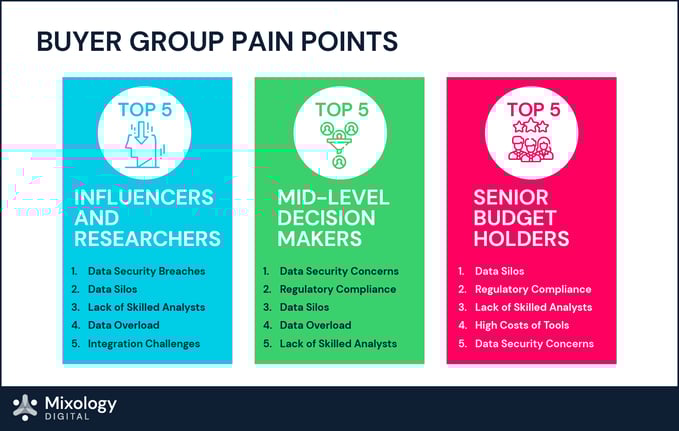
As HR technology stacks expand across recruitment, payroll, analytics and talent systems, buying groups are increasingly judged on how well workforce data can be unified, trusted and acted on. The focus has shifted from individual tools to whether the HR ecosystem supports better hiring decisions, workforce planning, compliance and consistent people decisions at scale. Our report shows how the emphasis on these factors shifts by role and seniority.
What does this mean for your persona development?
Tailoring content to buyer role nuances is critical for engagement and conversion. Here's how you can translate these insights into accurate personas.
Persona A: Influencers and researchers (such as HR analysts, people operations managers or talent analysts)
- Concerns: high turnover, skill gaps and employee burnout dominate early research, indicating a focus on diagnosing root causes rather than selecting tools.
- Content preferences: they want educational, problem-framing content that explains trends, risks and emerging approaches without vendor bias.
Persona B: Mid‑level decision makers (such as heads of HR, HR managers or talent acquisition managers)
- Concerns: compliance issues, burnout and technology adoption feature strongly, reflecting accountability for execution and governance.
- Content preferences: they want practical guidance, checklists and examples that help them assess feasibility, integration and internal impact.
Persona C: Senior budget holders (such as CHROs, COOs or CFOs)
- Concerns: high turnover, lack of engagement and compliance risks are viewed through a cost, continuity and accountability lens.
- Content preferences: they want concise, outcome-driven content that quantifies risk, ROI and long-term business alignment.
Action point: Create a persona matrix aligned to job functions (e.g. network engineer vs. CTO). Map their pain points against the funnel stages they are most likely to participate in. For example, analysts may engage early (implementation and best‑practice content), while senior leaders will respond to BOFU tools like ROI models and rollout risk frameworks.
Recommended reading: How to map content to the new buyer journey
3 HR technology demand gen plays:
Our AI Buyer Intelligence platform is able to interrogate research patterns by buyer stage. Here's how to action these insights into a full-funnel demand gen strategy aligned to real buyer behaviour:
Tip: Keep the exact keyword phrases in page titles, H2s, alt text, and internal links so performance teams can tie content to intent spikes and prioritise syndication/remarketing accordingly.
Ready to activate these insights?
Why not try our demand gen planning framework? It’s a collection of templates and planning aids, including:
- Buyer group intent mapping
- Multichannel campaign blueprint
- Funnel‑aligned strategy shortcuts
Everything you need to turn category intent insights into campaigns that convert.