




Read time: 9 minutes
What’s been happening in the data and analytics sector over the last 3 months?
Our Buyer Intelligence platform has been continuously tracking first-party buyer signals across our database, bringing you timely insights in the form of our latest data and analytics intent report.
Our mission? To help tech vendors keep their demand generation strategies tightly aligned to real market demand.
Published quarterly as part of our category-specific intent reports, our latest blog takes a deeper dive into the shifts most likely to impact your data and analytics — and how you can action these insights to drive success.
Ready to level up your strategy? Let's go...

This quarter vs last quarter: what’s changed?
Data and analytics buyer behaviour shifted meaningfully from Q4 2025 to Q1 2026. Broad exploration of big data technologies and predictive analytics has given way to something more foundational, with intent signals pointing to buyers focused on data quality, governance, and the integration challenges standing between fragmented data environments and usable analytics.
Four key shifts stand out:
- Data quality and governance have become foundational priorities, with Q1 awareness research shifting from predictive analytics and big data technologies toward governance frameworks, data quality management, and real-time processing
- Integration challenges have emerged as a key operational barrier, appearing as a new pain point for influencers and researchers as organizations struggle to connect fragmented data environments into usable analytics workflows
- Analytics platform evaluation is becoming more structured, with consideration-stage research moving from general platform exploration toward vendor comparison and cost-benefit analysis as analytics platforms become core infrastructure investments
- Machine learning remains the central driver of analytics interest, with ML models holding the top research position and data quality management surging alongside it, reflecting sustained demand for AI-driven insights supported by stronger data foundations.
Together, these signals point to a buyer base that is pausing to strengthen its data infrastructure before expanding advanced analytics initiatives, and content strategies that meet buyers at that point will outperform those still leading with AI capability.
Market snapshot
Here's what our latest networking and comms intent report reveals about the current market:
- Interest is strongest in the technology, finance, and healthcare industries.
- Traction is highest among enterprises with 1,000–5,000+ employees.
- Data analyst, data scientist and business analyst functions show the greatest engagement with data and analytics topics.
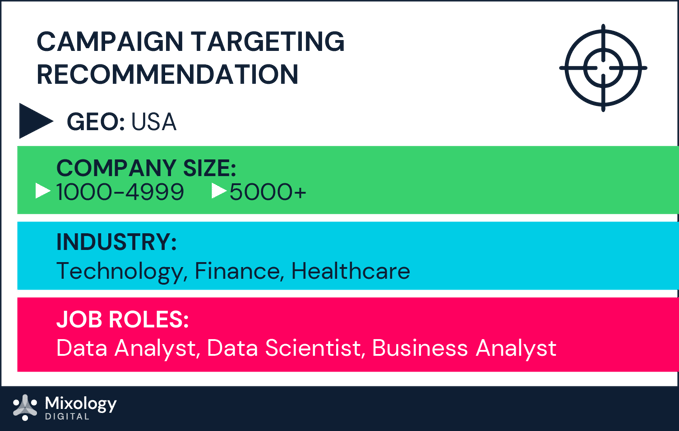
From insight to impact, here's how to apply our insight into your campaigns:
Targeting and segmentation action points:
1. Segment enterprise organisations in surging industries and geos into priority tiers.
2. Within these tiers, filter intent signals among trending job functions to inform topic clusters.
Why?
Segmenting your market into priority tiers helps to focus go-to-market teams on the accounts most likely to convert. Further segmentation techniques such as topic clusters opens up opportunities to tightly align content to specific audience segments. The result? Relevancy at scale.
Research patterns at account level
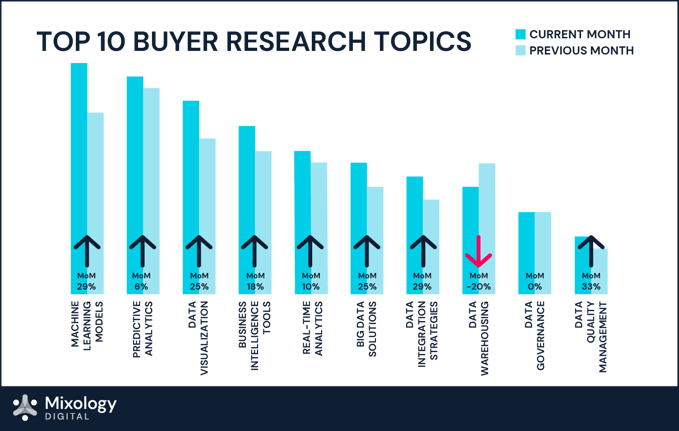
5 hot topics dominating research in the data and analytics space (over the last 3 months), are:- Machine learning models – Interest continues to accelerate as buyers explore predictive and automated decisioning beyond descriptive analytics.
- Predictive analytics – Teams are increasingly focused on forward-looking insights that support planning, forecasting, and risk mitigation.
- Data visualization – Demand reflects the need to make complex data accessible and actionable for non-technical stakeholders.
- Business intelligence – Core BI remains critical as organisations look to consolidate reporting and improve decision confidence across the business.
- Real-time analytics – Buyers are moving beyond batch processing toward continuous data streams that enable faster responses to customer behavior, operational events, and market changes.
The topic showing the greatest decline in popularity is:
- Data warehousing with a 20% MoM decrease
What do these insights mean for your content strategy?
To keep your strategy aligned to market demand, we recommend:
- Lead with data quality and governance before analytics capability — the shift in Q1 awareness research from predictive analytics toward governance frameworks and data quality management tells you buyers are focused on getting their data foundations right first; content that addresses that directly, rather than jumping straight to ML or AI capability, will resonate more with where buyers actually are.
- Make machine learning and predictive analytics content outcome-led — these are the top two research topics by volume, but buyers are past introductory content; focus on specific business outcomes, use case examples, and the data infrastructure requirements that make ML initiatives successful in practice.
- Address integration directly — it has emerged as a new pain point for influencers and researchers, and if buyers can't see how a platform connects with their existing data environment, evaluation stalls; practical integration guidance, architecture examples, and interoperability content will reduce that friction and move buying decisions forward.
Pro tip: Use AI/NLP tools (topic modelling, entity extraction, semantic clustering) to audit your content library against competitor coverage. Flag underserved subtopics and build differentiated assets where demand is growing fastest.
Buyer group analysis
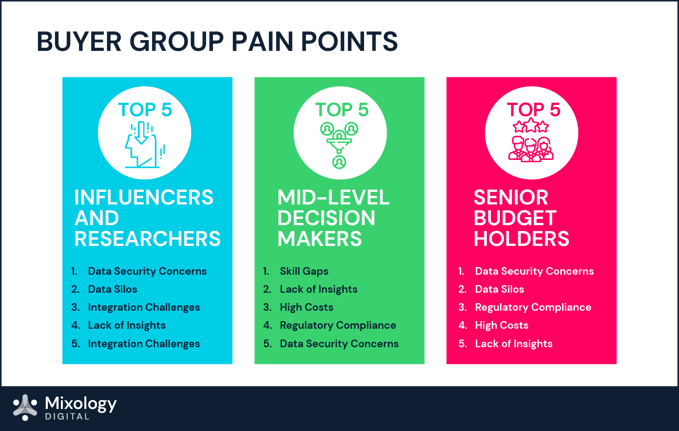
As data volumes grow and analytics environments span cloud platforms, distributed teams, and multiple business units, buyers are being judged on how effectively data can be trusted, accessed, and turned into insight. The focus has shifted to whether analytics foundations support predictive use cases, scalable cloud data services, and consistent decision-making across the organisation. Our report shows how the emphasis on these factors shifts by role and seniority.
What does this mean for your persona development?
Tailoring content to buyer role nuances is critical for engagement and conversion. Here's how you can translate these insights into accurate personas.
Persona A: Influencers and researchers (such as data scientists or data analysts)
- Concerns: data security concerns and data silos, alongside integration challenges and lack of insights. This group is dealing with the practical barriers that prevent data from being usable: fragmented environments, broken integrations, and analytics outputs that don't yet deliver the clarity stakeholders need.
- Content preferences: they want technical guides on data integration, governance frameworks, and data quality best practices that help them build a credible case for investment in stronger data infrastructure.
Persona B: Mid‑level decision makers (such as heads of data and analytics or BI managers)
- Concerns: skill gaps and lack of insights, followed by high costs, regulatory compliance, and data security concerns. This group is accountable for analytics outcomes and is increasingly frustrated by the gap between data investment and the quality of insight it produces, compounded by a shortage of the technical talent needed to close it.
- Content preferences: they want vendor comparison frameworks, ROI evidence, and practical implementation examples that demonstrate how analytics platforms can deliver value without requiring deep technical expertise to operate.
Persona C: Senior budget holders (such as CDOs or CIOs)
- Concerns: data security concerns and data silos, followed by regulatory compliance, high costs, and lack of insights. This group is most focused on risk and governance, with compliance and security sitting prominently alongside cost as indicators that data investments are being scrutinised at board level.
- Content preferences: they want business-level narratives, compliance assurance, and ROI evidence. Content that connects data governance and security investment to measurable risk reduction and business performance.
Action point: Create a persona matrix aligned to job functions (e.g. network engineer vs. CTO). Map their pain points against the funnel stages they are most likely to participate in. For example, analysts may engage early (implementation and best‑practice content), while senior leaders will respond to BOFU tools like ROI models and rollout risk frameworks.
Recommended reading: How to map content to the new buyer journey
3 data and analytics demand gen plays:
Our AI Buyer Intelligence platform is able to interrogate research patterns by buyer stage. Here's how to action these insights into a full-funnel demand gen strategy aligned to real buyer behaviour:
Tip: Keep the exact keyword phrases in page titles, H2s, alt text, and internal links so performance teams can tie content to intent spikes and prioritise syndication/remarketing accordingly.
Ready to activate these insights?
Why not try our demand gen planning framework? It’s a collection of templates and planning aids, including:
- Buyer group intent mapping
- Multichannel campaign blueprint
- Funnel‑aligned strategy shortcuts
Everything you need to turn category intent insights into campaigns that convert.