




Read time: 9 minutes
What’s been happening in the DevOps sector over the last 3 months?
Our Buyer Intelligence platform has been continuously tracking first-party buyer signals across our database, bringing you timely insights in the form of our latest DevOps intent report.
Our mission? To help tech vendors keep their demand generation strategies tightly aligned to real market demand.
Published quarterly as part of our category-specific intent reports, our latest blog takes a deeper dive into the shifts most likely to impact your DevOps campaigns — and how you can action these insights to drive success.
Ready to level up your strategy? Let's go...

This quarter vs last quarter: what’s changed?
Developer and DevOps buyer behaviour shifted meaningfully from Q4 2025 to Q1 2026. Broad infrastructure and containerization research has given way to something more operationally specific, with intent signals pointing to buyers focused on security, toolchain efficiency, and the financial justification of DevOps investments.
Four key shifts stand out:
- Security has become a central DevOps priority, with security vulnerabilities emerging as a new pain point for both mid-level decision makers and senior budget holders, and awareness research shifting toward cloud-native security practices and DevSecOps integration
- Toolchain complexity is emerging as a growing operational challenge, appearing as a new pain point for both influencers and senior budget holders as tool ecosystems expand and teams look to simplify workflows
- CI/CD performance optimization is gaining evaluation focus, with Q1 search behavior shifting from infrastructure and containerization trends toward pipeline optimisation and performance metrics
- DevOps investments are increasingly being evaluated through cost and risk, with decision-stage research moving toward cost-benefit analysis, risk assessment for tool adoption, and implementation roadmaps.
Together, these signals point to a buyer base that is maturing beyond initial DevOps adoption and is now focused on making their toolchains secure, efficient, and commercially justifiable.
Market snapshot
Here's what our latest DevOps intent report reveals about the current market:
- Interest is strongest in the IT, finance, and healthcare industries.
- Traction is highest among enterprises with 1,000–5,000+ employees.
- Software development, IT operations, and project management functions show the greatest engagement with DevOps topics.
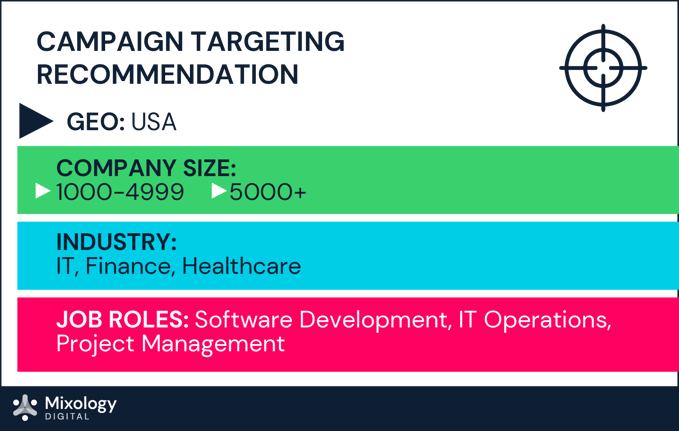
From insight to impact, here's how to apply our insight into your campaigns:
Targeting and segmentation action points:
1. Segment enterprise organisations in surging industries and geos into priority tiers.
2. Within these tiers, filter intent signals among trending job functions to inform topic clusters.
Why?
Segmenting your market into priority tiers helps to focus go-to-market teams on the accounts most likely to convert. Further segmentation techniques such as topic clusters opens up opportunities to tightly align content to specific audience segments. The result? Relevancy at scale.
Research patterns at account level
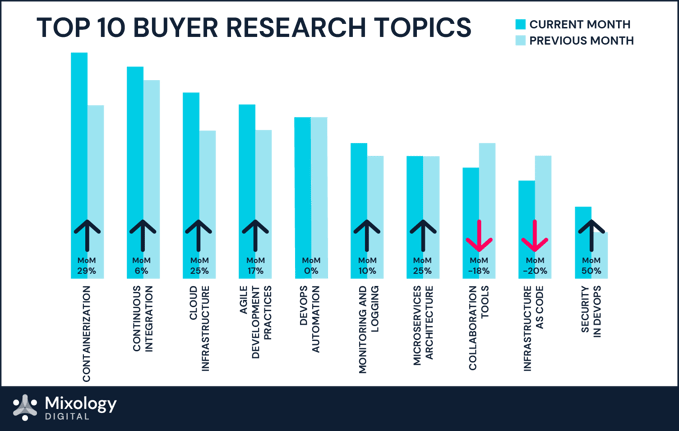
5 hot topics dominating research in the DevOps space (over the last 3 months), are:- Containerization – The most researched topic in the category, reflecting sustained demand for container-based deployment strategies as organisations look to improve portability, consistency, and scalability across their development environments.
- Continuous integration – Consistently high research volume as organisations focus on automating build and test processes to reduce manual effort, catch errors earlier in the pipeline, and improve overall delivery speed and reliability.
- Cloud infrastructure – Strong buyer interest as development teams evaluate how to optimise the underlying infrastructure that supports their DevOps workflows, with a focus on scalability, cost control, and performance.
- Agile development practices – Sustained research interest as organisations look to align development processes more closely with business outcomes, improve team collaboration, and reduce time-to-market across iterative delivery cycles.
- DevOps automation – Steady research volume as teams look to reduce manual intervention across build, test, and deployment workflows, freeing up engineering capacity and improving consistency across release pipelines.
The topic showing the greatest decline in popularity is:
- Infrastructure as code (IaC) with a 20% MoM decrease
What do these insights mean for your content strategy?
To keep your strategy aligned to market demand, we recommend:
- Make security a first-class topic in your content mix: security in DevOps is the fastest-growing topic in the category and security vulnerabilities now appear across all three buyer group pain point lists; content that addresses DevSecOps practices, CI/CD pipeline security, and cloud-native security without framing it as a slowdown to delivery will resonate across every persona.
- Lead containerization and CI/CD content with outcomes, not mechanics: these are the highest-volume research topics, but buyers are past the basics; content that connects containerization and continuous integration to measurable improvements in deployment speed, error rates, and team efficiency will outperform introductory or concept-led content.
- Build toolchain simplification into your messaging: toolchain complexity is a new and fast-moving pain point for both influencers and senior budget holders, so content that addresses platform consolidation, reduced operational overhead, and improved developer experience speaks directly to a concern that is growing across the buying group.
Pro tip: Use AI/NLP tools (topic modelling, entity extraction, semantic clustering) to audit your content library against competitor coverage. Flag underserved subtopics and build differentiated assets where demand is growing fastest.
Buyer group analysis
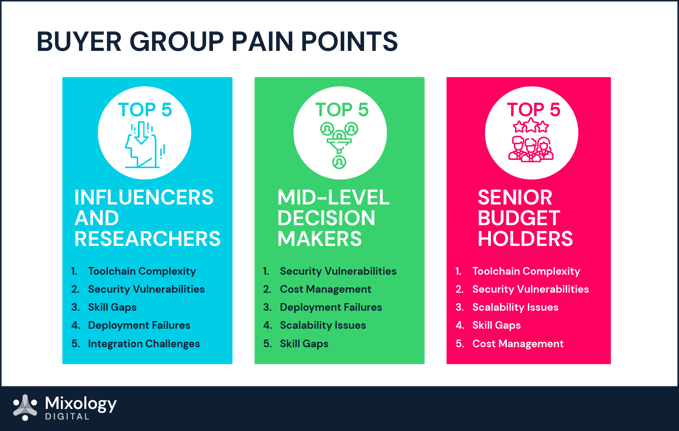
For DevOps buyers, the pressure is no longer theoretical. As platforms sprawl and pipelines multiply, teams are being judged on how quickly they can ship, how reliably they can recover, and how consistently DevOps holds up under real-world scale. Our report shows how the emphasis on these factors shifts by role and seniority.
What does this mean for your persona development?
Tailoring content to buyer role nuances is critical for engagement and conversion. Here's how you can translate these insights into accurate personas.
Persona A: Influencers and researchers (such as software engineers and DevOps engineers)
- Concerns: toolchain complexity leads, alongside security vulnerabilities, skill gaps, deployment failures, and integration challenges. This group is dealing with the operational friction of sprawling DevOps environments day to day, and the combination of complexity, skill gaps, and integration challenges points to teams struggling to keep pace with the tools they're expected to manage.
- Content preferences: they want technical guides, toolchain comparisons, and DevSecOps integration frameworks that help them reduce complexity and make a practical case for change.
Persona B: Mid‑level decision makers (such as DevOps managers and team leads)
- Concerns: security vulnerabilities lead, followed by cost management, deployment failures, scalability issues, and skill gaps. This group is most focused on security risk and its commercial consequences, with cost management sitting second, signalling they're being held accountable for the financial impact of their tooling decisions.
- Content preferences: they want vendor comparison frameworks, cost-benefit analysis templates, and case studies with measurable outcomes that reduce decision risk and support the internal business case.
Persona C: Senior budget holders (CTOs, CIOs)
- Concerns: while influencers flag toolchain complexity as an operational problem, senior budget holders flag it as a governance and investment concern, with scalability and cost sitting alongside it, reflecting a focus on whether current DevOps infrastructure can support future growth.
- Content preferences: they want business-level narratives, ROI evidence, and risk reduction frameworks, including implementation roadmaps, cost modelling tools, and content that connects DevOps maturity to measurable business outcomes.
Action point: Create a persona matrix aligned to job functions (e.g. platform engineer vs. VP of Engineering). Map their pain points against the funnel stages they are most likely to participate in. For example, engineers and SREs may engage early (implementation and best‑practice content), while senior engineering leaders will respond to BOFU tools like ROI models and rollout risk frameworks.
Recommended reading: How to map content to the new buyer journey
3 DevOps demand gen plays:
Our AI Buyer Intelligence platform is able to interrogate research patterns by buyer stage. Here's how to action these insights into a full-funnel demand gen strategy aligned to real buyer behaviour:
Tip: Keep the exact keyword phrases in page titles, H2s, alt text, and internal links so performance teams can tie content to intent spikes and prioritise syndication/remarketing accordingly.
Ready to activate these insights?
Why not try our demand gen planning framework? It’s a collection of templates and planning aids, including:
- Buyer group intent mapping
- Multichannel campaign blueprint
- Funnel‑aligned strategy shortcuts
Everything you need to turn category intent insights into campaigns that convert.